

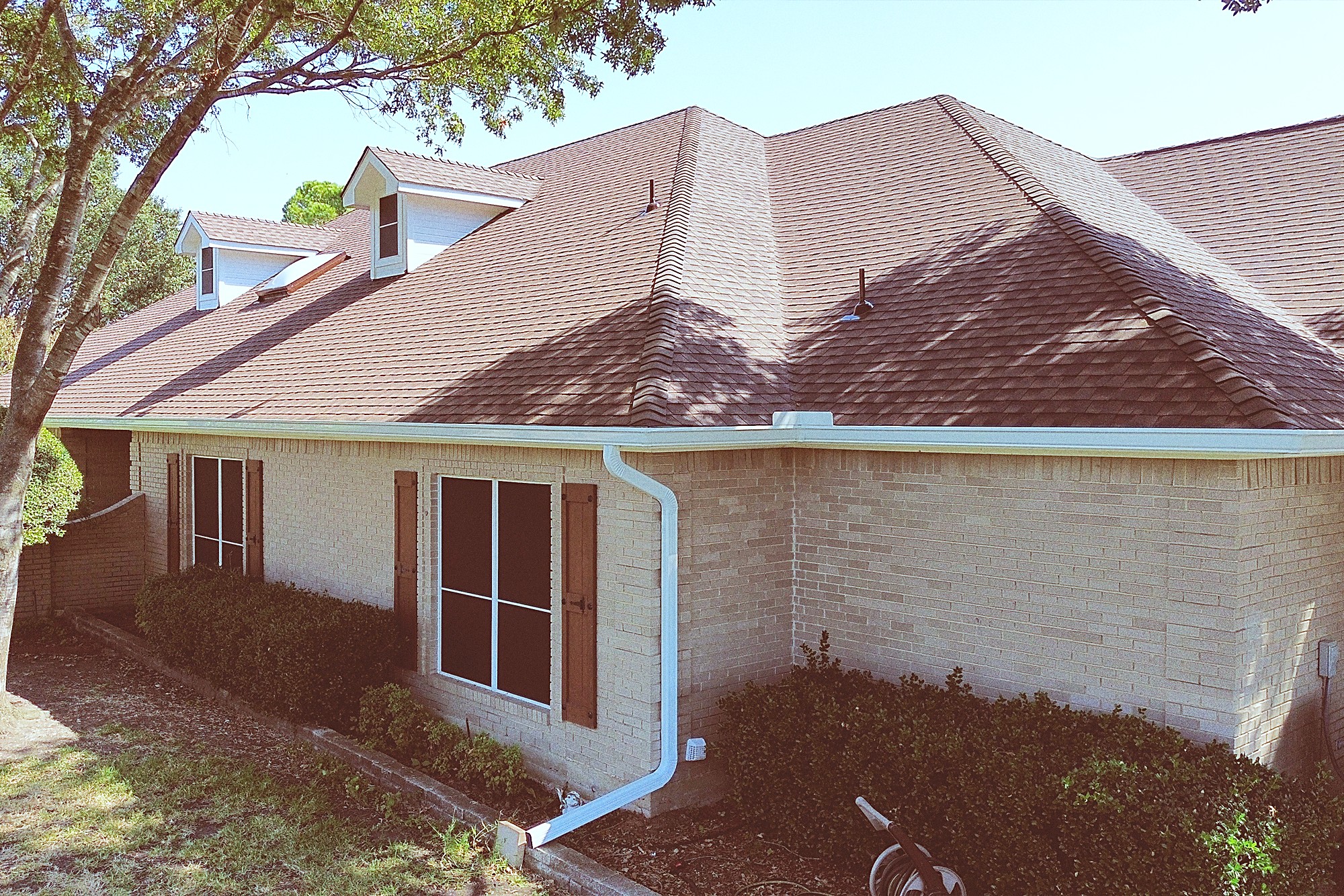
What size gutters does my house need?
Most single-story homes do well with five-inch K-style gutters and two-by-three or three-by-four downspouts. Large, steep or two-story roofs, and long runs where a lot of roof drains to one corner, usually need six-inch gutters with three-by-four downspouts. The deciding factors are roof area, pitch, rainfall intensity and how far water travels to each downspout.
A gutter is sized for the worst ten minutes of the year
An average rain is not the test. The test is a spring thunderstorm that drops more than an inch in half an hour, which North Texas gets most years. A gutter that handles a steady shower and overflows in that storm fails exactly when it matters, sending sheets of water onto the beds and the slab.
That is why gutter sizing starts from rainfall intensity rather than annual rainfall. Rockwall averages somewhere around forty inches a year, but it arrives in heavy bursts, and the bursts decide the size.
Roof area and pitch set how much water arrives
Every square foot of roof that drains to a gutter adds water to it. A long single-story ranch spreads its roof over many short runs, while a two-story home with a big main roof can funnel a large area into a single run along the back.
Pitch matters as well. A steep roof sheds water faster and with more momentum, so the gutter has to catch a quicker surge, and in a hard rain the water can overshoot a shallow gutter entirely. Steeper roofs are one of the most common reasons to step up to six inches.
Six inches carries roughly forty percent more
A six-inch K-style gutter holds substantially more water than a five-inch one, commonly quoted at around forty percent more capacity. It costs a little more per foot and it is visibly larger on the house, which matters on some homes and not on others.
Downspouts are often the real bottleneck. A gutter can only empty as fast as its downspouts let it, and a three-by-four downspout moves far more water than a two-by-three. Adding a downspout to a long run can fix overflowing just as well as a bigger gutter.
Where the water goes after the downspout matters just as much
Clay soil around Rockwall swells when it is wet and shrinks when it dries, and a slab sitting in unevenly wet soil moves. A downspout that empties right at the foundation defeats most of the reason for having gutters. Extensions, splash blocks or buried drain lines that carry water several feet away keep the soil around the house more even.
Related questions
Are seamless gutters better?
Seamless gutters are formed in one piece per run, so there are no joints along the length to leak or separate. They are the common choice on homes in this area.
How far should downspouts discharge from the house?
Several feet at least, and further on expansive clay. The goal is keeping water from soaking the soil right against the slab.